CRM Best Practices: How to Build Customer Relationships That Last
Customer Relationship Management isn't just software—it's a philosophy of putting customers at the center of everything you do. When implemented correctly, a CRM system becomes the nervous system of your sales and marketing operations, providing the insights and automation that transform good businesses into great ones. This guide covers the essential practices that make CRM systems deliver real value.
The statistics are compelling: businesses using CRM systems see an average ROI of $8.71 for every dollar spent. Sales teams with proper CRM implementation close 30% more deals. Customer retention rates improve by up to 27%. Yet many small businesses struggle to realize these benefits because they focus on the tool rather than the practices that make the tool effective.
Understanding the True Purpose of CRM
Before diving into best practices, it's essential to understand what CRM actually accomplishes. At its core, CRM solves a fundamental business problem: as your customer base grows, maintaining personal, relevant relationships with each customer becomes impossible without systems. CRM provides the memory, organization, and automation that allow small teams to manage large customer bases while still delivering personalized experiences.
Think of your CRM as a shared brain for your entire organization. Every interaction a customer has with your company—from the first marketing email to the most recent support ticket—should be captured and accessible. This comprehensive view enables anyone in your organization to understand each customer's history, needs, and value, leading to better decisions and stronger relationships.
Best Practice 1: Make Data Entry Non-Negotiable
The most sophisticated CRM in the world is useless without accurate, complete data. Every customer interaction must be logged. Every contact detail must be current. Every deal must be tracked through your pipeline. This sounds obvious, but data entry discipline is where most CRM implementations fail.
Create a simple rule: if it's not in the CRM, it didn't happen. Salespeople who keep notes in their heads or personal spreadsheets are doing themselves and the organization a disservice. When they leave, that knowledge leaves with them. When they're sick, no one can follow up on their opportunities. Make CRM data entry a non-negotiable expectation with clear accountability.
Essential Data to Capture for Every Contact
- Full name and job title
- Company and industry
- Phone and email
- Lead source
- Key pain points
- Decision-making role
- Budget and timeline
- Communication preferences
Best Practice 2: Define and Follow Your Sales Process
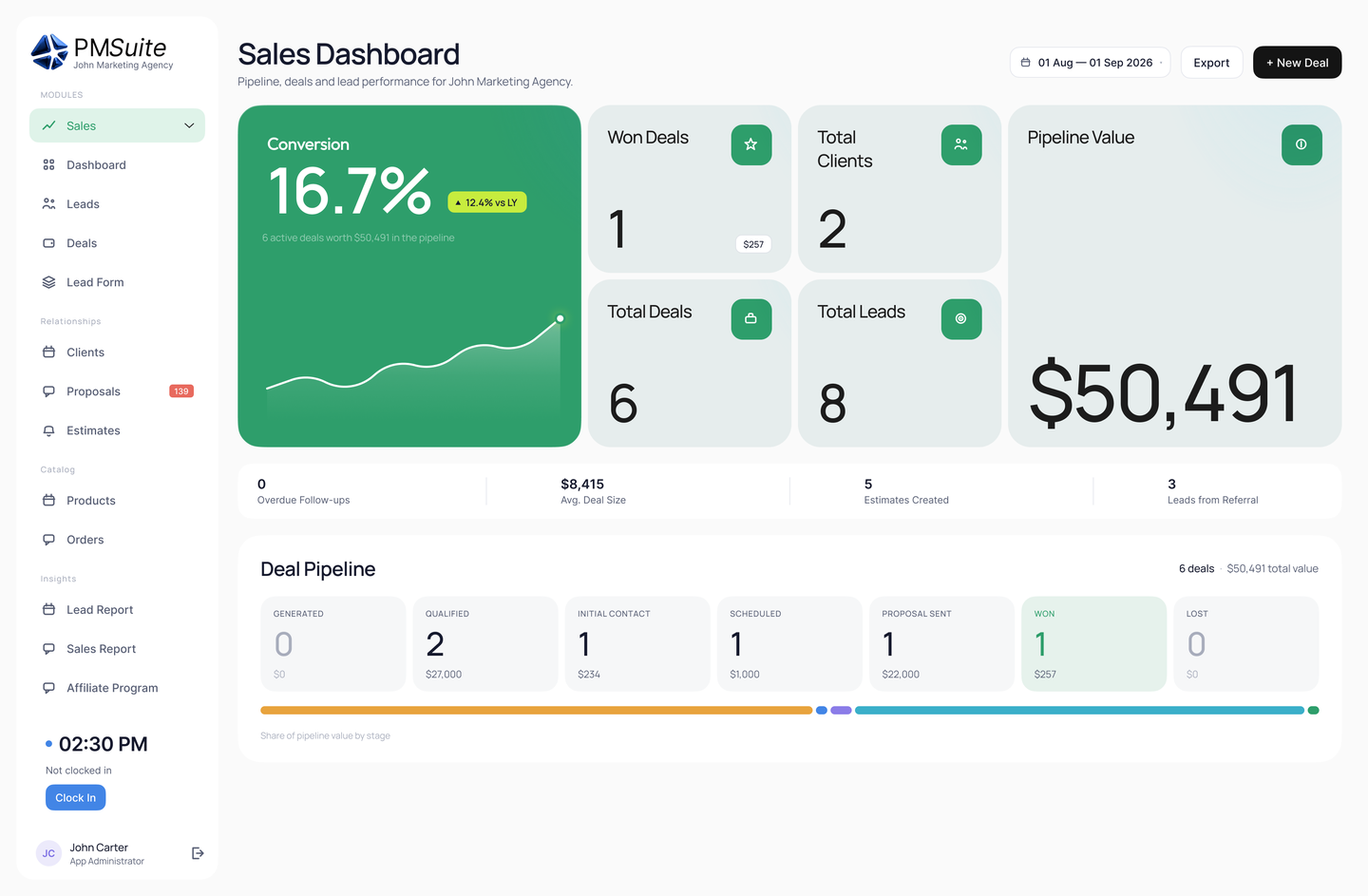
Your CRM should reflect a clearly defined sales process with distinct stages from initial contact to closed deal. Each stage should have specific criteria for entry and exit. When a lead moves from "Qualified" to "Proposal Sent," everyone should understand exactly what that means and what actions should follow.
Mapping your sales process to your CRM does several things: it creates consistency across your team, enables accurate forecasting, identifies bottlenecks, and ensures no opportunities fall through the cracks. Without a defined process, your pipeline becomes a disorganized collection of deals rather than a predictable revenue engine.

PMSuite's deal pipeline helps visualize your sales process and track opportunities through each stage.
Best Practice 3: Segment Your Customers Strategically
Not all customers are created equal. Some bring more revenue, some have higher potential, some require more support. Effective CRM usage involves segmenting your customers into meaningful groups and tailoring your approach to each segment. This enables personalized communication at scale and optimal resource allocation.
Common segmentation criteria include customer lifetime value, industry or vertical, company size, purchase history, engagement level, and geographic location. Create segments that align with your business strategy. A software company might segment by user count; a consulting firm might segment by project type. The key is creating groups where members have similar needs and respond to similar approaches.
Best Practice 4: Automate Routine Communications
Modern CRM systems excel at automation. Welcome emails to new leads, follow-up reminders for sales reps, anniversary messages to long-term customers—these routine communications should happen automatically based on triggers you define. Automation ensures consistency and frees your team to focus on high-value activities.
Start with the most impactful automations: immediate response to new inquiries, follow-up sequences for proposals, renewal reminders for existing customers, and re-engagement campaigns for dormant accounts. Each automation should feel personal—use customer data to personalize content and timing. The goal is efficiency that enhances rather than replaces genuine human connection.
Best Practice 5: Track the Right Metrics
Your CRM generates vast amounts of data. The challenge is focusing on metrics that drive decisions and improve outcomes. Vanity metrics—total contacts, raw lead counts—matter less than actionable metrics like conversion rates, average deal size, sales cycle length, and customer lifetime value.
Build dashboards that answer your most important questions: How full is our pipeline? Where are deals stalling? Which lead sources perform best? What's our retention rate? Review these metrics regularly with your team, identify trends, and take action on insights. Data without action is just noise; data that drives improvement is gold.
Best Practice 6: Integrate Everything
A CRM that exists in isolation loses much of its value. Integration with email, calendar, marketing automation, support systems, and accounting software creates a complete picture of each customer relationship. When your sales rep can see support tickets while preparing for a client call, they can address concerns proactively. When marketing can see sales outcomes, they can optimize campaigns based on what actually closes deals.
Prioritize integrations based on data flow. Email and calendar integration should be immediate—this is where most customer communication happens. Marketing automation integration enables lead scoring and nurture campaigns. Support integration prevents sales from selling to unhappy customers. Accounting integration reveals true customer profitability.
Best Practice 7: Maintain Data Quality Relentlessly
CRM data degrades over time. People change jobs, companies move, email addresses become invalid, phone numbers change. Without regular maintenance, your database becomes increasingly unreliable. Schedule regular data cleaning: verify contact information, merge duplicates, archive inactive records, and standardize entries.
Implement data quality controls at entry: required fields, format validation, duplicate checking. Create processes for updating records when bounced emails or disconnected phone numbers reveal outdated information. Consider using data enrichment services to fill gaps and verify accuracy. The cost of maintaining clean data is far less than the cost of acting on bad data.
Best Practice 8: Train Your Team Thoroughly
CRM adoption fails when users don't understand the system or don't see its value. Invest in comprehensive training that covers not just button clicking but why each feature matters and how it benefits the user. Show salespeople how the CRM helps them close more deals, not just how it helps management track them.
Training should be ongoing, not one-time. Schedule regular refreshers, share tips and shortcuts, celebrate users who excel at CRM adoption. Create internal champions who can help colleagues and advocate for the system. When issues arise, provide immediate support rather than letting frustration build. Success with CRM is as much about change management as technology implementation.
Best Practice 9: Use CRM for Customer Success, Not Just Sales
Many businesses treat CRM as purely a sales tool, but its greatest value may be in customer retention and expansion. Existing customers are far more valuable than new prospects—they cost less to serve, buy more over time, and refer others. Your CRM should support the entire customer lifecycle, not just the acquisition phase.
Track customer health indicators: product usage, support ticket frequency, contract renewal dates, satisfaction scores. Set up alerts for at-risk accounts. Create playbooks for customer success actions at key milestones. Use customer data to identify expansion opportunities—who's ready for an upgrade, a cross-sell, an additional product? The same CRM that helps you win customers can help you keep and grow them.
Best Practice 10: Continuously Improve Your System
Your CRM implementation is never finished. As your business evolves, your CRM should evolve with it. New products require new tracking. Changed processes require updated workflows. Growing teams require refined permissions. Schedule regular reviews to assess whether your CRM configuration still serves your needs.
Gather feedback from users about what's working and what's frustrating. Analyze usage data to identify underutilized features and processes that could be streamlined. Stay current on CRM updates and new capabilities. Treat your CRM as a living system that grows more valuable over time as you refine and optimize it.
Common CRM Mistakes to Avoid
Understanding what not to do is as important as knowing best practices. Here are the most common CRM mistakes that undermine success:
Over-customization: It's tempting to customize every field and process, but complexity creates barriers to adoption. Start simple and add complexity only when clearly needed. Every custom field should have a clear purpose and user benefit.
Ignoring mobile: Your sales team is often in the field. If your CRM isn't easily usable on mobile devices, data entry will suffer. Choose a system with strong mobile capabilities and ensure key workflows work on phones and tablets.
Treating CRM as surveillance: When salespeople feel CRM is just a way for management to monitor them, resistance builds. Position CRM as a tool that helps individuals succeed, not just a reporting mechanism. Share insights from CRM data with the team, not just leadership.
Setting and forgetting automations: Automated communications can become stale or irrelevant. Review your automation rules and content regularly. What worked last year may not work today. Test and optimize continuously.
Measuring CRM Success
How do you know if your CRM practices are working? Track these indicators over time:
Adoption metrics show whether your team is actually using the system: daily active users, records created and updated, login frequency, feature usage. High adoption is a prerequisite for other benefits.
Sales metrics reveal revenue impact: conversion rates at each pipeline stage, average deal size, sales cycle length, win rates against competitors, quota attainment. Compare these before and after CRM optimization.
Customer metrics indicate relationship health: retention rates, customer lifetime value, expansion revenue, referral rates, satisfaction scores. These often show the most dramatic improvements from good CRM practices.
Efficiency metrics demonstrate operational benefits: time spent on data entry, time to follow up on leads, administrative overhead, reporting time. Effective CRM should reduce friction and increase productive time.
Building a Customer-Centric Culture
Ultimately, CRM best practices are about more than software—they're about building an organization that genuinely prioritizes customer relationships. The technology enables and supports this priority, but the cultural commitment must come first.
When every team member understands how their actions impact customer experience, when data is trusted and used for decisions, when processes are designed around customer needs rather than internal convenience, CRM becomes transformative. The practices in this guide create the foundation for that transformation, turning customer relationship management from a software category into a competitive advantage.
Ready to put these practices into a system? See how PMSuite’s CRM software for small businesses handles leads, deals and client follow-ups, and compare PMSuite pricing plans.
Build Better Customer Relationships with PMSuite
Our CRM module gives you pipeline management, contact organization, deal tracking, and automation—everything you need to implement these best practices in one integrated platform.
Start Your Free Trial7-day free trial • No credit card required