15 Project Management Tips That Actually Work for Small Teams
Managing projects with a small team presents unique challenges and opportunities. Without the bureaucracy of large organizations, small teams can be agile and responsive—but they can also fall into chaos without proper structure. These fifteen battle-tested project management tips will help your team deliver consistently without drowning in process.
The difference between successful small teams and struggling ones often comes down to how well they manage their work. Great project management isn't about following rigid methodologies or filling out endless status reports. It's about creating just enough structure to keep everyone aligned while preserving the flexibility that makes small teams powerful.
Tip 1: Start Every Project with a Clear Definition of Done
Before writing a single line of code or creating the first deliverable, get crystal clear on what "done" means for your project. This sounds obvious, but it's where most project failures begin. Without a shared understanding of success, team members pull in different directions, stakeholders have mismatched expectations, and scope creep becomes inevitable.
Create a simple document that answers these questions: What specific outcomes will this project deliver? What is explicitly out of scope? How will we know when we're finished? Who needs to approve the final deliverables? Share this with every stakeholder and get explicit buy-in before starting work. This ten-minute conversation can save weeks of rework later.
Tip 2: Break Projects into Two-Week Chunks
Large projects are overwhelming and unpredictable. Breaking them into two-week sprints or phases makes them manageable and gives you regular checkpoints to assess progress. Two weeks is long enough to accomplish meaningful work but short enough to course-correct before problems compound.
At the start of each two-week period, identify the three to five most important deliverables. At the end, review what was accomplished, what blocked progress, and what you learned. This rhythm creates natural accountability and prevents the "we'll catch up later" mentality that derails so many projects.
Tip 3: Limit Work in Progress
Nothing kills productivity like context switching. When team members juggle multiple projects simultaneously, each task takes longer, quality suffers, and stress increases. Implement strict work-in-progress limits: each person should focus on one or two active tasks at most.
This feels counterintuitive—shouldn't we maximize utilization? But research consistently shows that limiting concurrent work increases throughput. A developer switching between three projects might complete each in three weeks. The same developer focusing sequentially might finish each in one week, completing all three in the same time but with better quality and less stress.
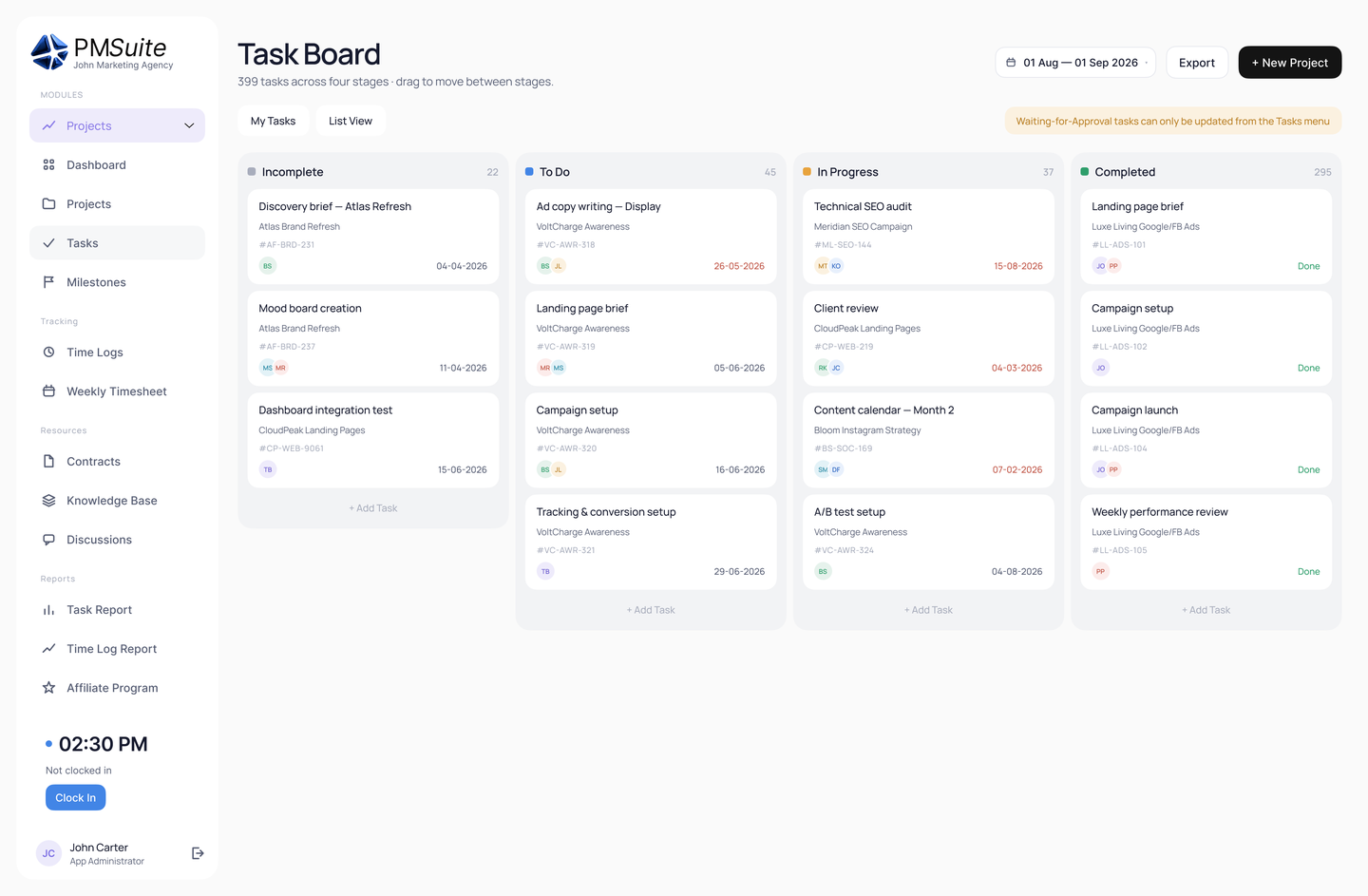
PMSuite's project boards make it easy to visualize work in progress and identify bottlenecks.
Tip 4: Make Dependencies Visible
In small teams, dependencies between tasks often remain implicit—everyone assumes everyone else knows who's waiting on what. This works until it doesn't. Make dependencies explicit by mapping them visually. When you can see that Task C can't start until Tasks A and B are complete, you can prioritize accordingly and communicate delays immediately.
Use your project management tool to link dependent tasks. Review dependencies in team meetings. When something is blocked, the blocker should appear prominently until it's resolved. This visibility transforms dependencies from hidden landmines into manageable handoffs.
Tip 5: Hold Daily Standups (But Keep Them Short)
Daily standup meetings get a bad reputation because teams do them wrong. A standup should be fifteen minutes maximum, focused on three questions: What did you complete yesterday? What will you complete today? What's blocking you? That's it. No problem-solving, no extended discussions, no status reports.
The purpose of standup is synchronization, not communication. It's a quick pulse check that ensures everyone knows the day's priorities and surfaces blockers early. If issues require discussion, note them and schedule a separate conversation with only the relevant people. Done right, standups save time by preventing miscommunication and catching problems early.
Tip 6: Document Decisions, Not Discussions
Small teams often rely on verbal communication, which works until someone forgets a key decision or a new team member joins. You don't need extensive documentation, but you do need to capture decisions. When your team decides to change the project scope, switch to a different technology, or modify a deadline, write it down.
Create a simple decision log: date, decision, reasoning, and who made it. This takes thirty seconds per decision and saves hours of "I thought we agreed..." debates. It also helps new team members understand why things are the way they are without lengthy explanations.
Tip 7: Build Buffer Time into Estimates
Every experienced project manager knows that tasks take longer than estimated. Yet we consistently underestimate, creating unrealistic schedules that set teams up for failure. The planning fallacy—our tendency to be optimistic about our own work—is incredibly persistent.
Add buffer time explicitly. If a task seems like it will take three days, schedule five. If a project looks like a month, plan for six weeks. This isn't padding or sandbagging—it's acknowledging reality. Unexpected issues arise. Dependencies shift. People get sick. Building in buffer time transforms tight deadlines from sources of stress into manageable targets.
The 50% Buffer Rule
For most projects, adding 50% to your initial estimate gets you close to reality:
- 3-day task → Schedule 4-5 days
- 2-week sprint → Plan for 3 weeks of work
- Month-long project → Allow 6 weeks total
Tip 8: Assign Clear Ownership
When everyone is responsible, no one is responsible. Every task, deliverable, and decision should have a single owner—one person accountable for making sure it gets done. This doesn't mean they do all the work themselves, but they're responsible for coordinating, following up, and reporting on progress.
Ownership also applies to problems. When an issue arises, immediately assign someone to own its resolution. Without clear ownership, problems linger in shared responsibility limbo while everyone assumes someone else is handling it. The question "who owns this?" should have an immediate, obvious answer for everything in your project.
Tip 9: Use One Tool for Everything
Small teams often accumulate tools over time: one for tasks, another for documents, a third for communication, a fourth for time tracking. This fragmentation creates overhead, loses information, and makes it impossible to see the full picture. Consolidate into a single platform that handles all your project management needs.
The specific tool matters less than consistency. Whether you choose PMSuite, Asana, Monday, or another platform, commit to using it for everything project-related. Tasks, discussions, files, time tracking, and reporting should all live in one place. The thirty minutes you spend switching between tools each day adds up to weeks of lost productivity annually.
Tip 10: Communicate Status Before Being Asked
Nothing erodes trust faster than stakeholders having to chase you for updates. Establish a regular cadence of proactive status communication. Weekly summaries for ongoing projects, immediate updates for significant changes or blockers. When stakeholders know they'll receive regular updates, they stop interrupting with check-in requests.
Good status updates are brief and action-oriented. What was accomplished? What's planned for the next period? What risks or blockers exist? What decisions are needed? A well-structured weekly update takes five minutes to write and prevents hours of ad-hoc status meetings.
Tip 11: Conduct Post-Project Retrospectives
When a project ends, the natural instinct is to move immediately to the next thing. Resist this urge. Take an hour to conduct a retrospective: What went well? What went poorly? What will we do differently next time? This reflection transforms individual projects into organizational learning.
Document your retrospective findings and actually implement the improvements. Many teams conduct retrospectives but never change their behavior. Create specific, actionable changes: "We will start every project with a kickoff meeting" rather than "We should communicate better." Review past retrospectives before starting new projects to apply accumulated wisdom.
Tip 12: Protect Focus Time
Knowledge work requires sustained concentration. A developer interrupted every thirty minutes accomplishes a fraction of what they could with unbroken focus. Yet we fill calendars with meetings and expect Slack responses within minutes. This constant interruption is devastating to productivity.
Institute protected focus time. Block two to four hours daily where meetings are prohibited and instant responses aren't expected. Some teams do "no meeting Wednesdays." Others designate mornings for deep work and afternoons for collaboration. Whatever approach you choose, defend it fiercely. Focus time isn't a luxury—it's how actual work gets done.
Tip 13: Manage Scope Ruthlessly
Scope creep is the silent killer of projects. It starts innocently: "While we're building this, could we also add...?" Each individual addition seems reasonable, but they accumulate into an undeliverable monster. Managing scope requires saying no—a lot.
Establish a clear change control process. Any scope addition must be evaluated for impact on timeline, budget, and resources. Make trade-offs explicit: "We can add this feature, but it will push the deadline by two weeks." When stakeholders understand the true cost of additions, they become more selective about what they request.
Tip 14: Celebrate Milestones
Long projects are demoralizing without intermediate victories. Break your project into milestones and celebrate when you hit them. This doesn't require elaborate recognition—a team lunch, public acknowledgment in a meeting, or even a simple Slack message recognizing accomplishment keeps morale high.
Celebrations also create natural points to assess progress and realign the team. When you pause to acknowledge a milestone, you naturally reflect on how you got there and confirm you're still heading in the right direction. These moments of recognition and reflection are investment in your team's long-term effectiveness.
Tip 15: Build Relationships, Not Just Processes
The most efficient processes in the world won't save a team that doesn't trust each other. Small teams succeed when members genuinely want each other to succeed. This requires investment beyond task management: getting to know colleagues personally, understanding their goals and challenges, creating psychological safety for honest communication.
Make time for relationship building. Team lunches, casual conversations, and non-work activities strengthen bonds that make collaboration easier. When hard conversations are needed, strong relationships make them possible. When conflicts arise, trust enables resolution. Process is important, but people are essential.
Putting It All Together
These fifteen tips work together to create a project management approach that's light enough for small teams but robust enough to deliver consistently. Start by implementing the ones that address your biggest pain points. If you're constantly missing deadlines, focus on buffer time and scope management. If communication is chaotic, prioritize standups and status updates.
Remember that project management is a skill that improves with practice. Each project teaches you something about what works for your team in your context. Apply these tips, adapt them to your needs, and continuously refine your approach. The goal isn't perfect process—it's reliable delivery with sustainable effort.
The best small teams combine individual excellence with systematic approaches to collaboration. They work hard and they work smart. They're flexible but not chaotic, structured but not rigid. By applying these project management fundamentals, your small team can consistently punch above its weight, delivering projects that larger organizations would struggle to complete.
To apply these tips with your team, explore PMSuite’s project management software and compare PMSuite pricing plans.
Manage Projects Like a Pro with PMSuite
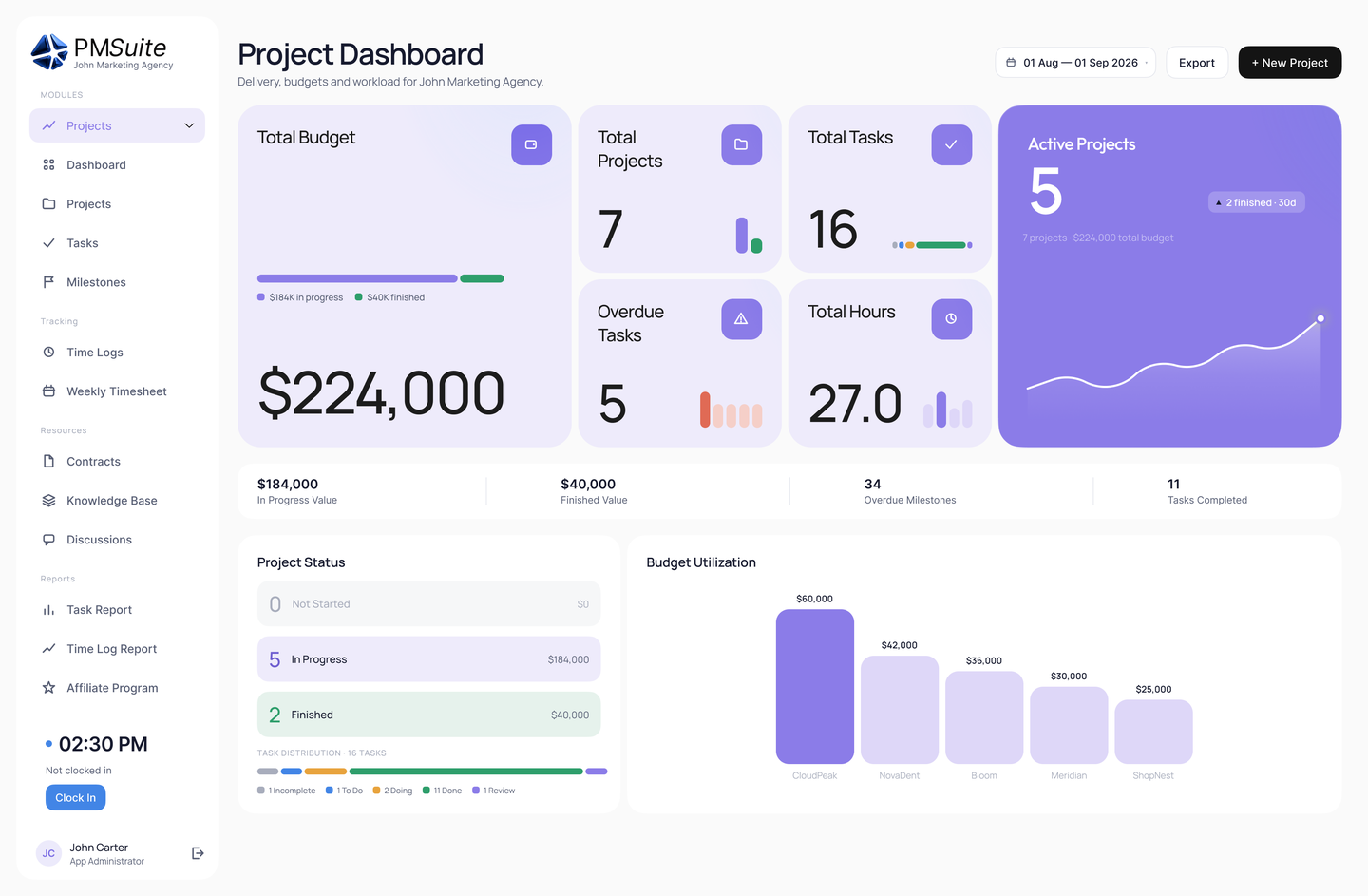
Our project management module gives you task boards, time tracking, dependencies, milestones, and reporting—everything you need to implement these tips in one integrated platform.
Start Your Free Trial7-day free trial • No credit card required