Team Management in the Remote Era: What's Changed and What Works

The way we work has fundamentally changed. Remote and hybrid arrangements that were once exceptions are now expectations. Managers who excelled at leading in-person teams often struggle to maintain effectiveness when their teams are distributed. This guide explores what's changed and what new skills successful remote team leaders develop.
Managing remote teams isn't just about transplanting office practices to digital tools. The challenges are different: communication requires more intention, culture requires more cultivation, and trust requires more explicit building. But the opportunities are also different: access to broader talent pools, increased flexibility, and often higher productivity from focused individual work.
What's Actually Different About Remote Work
In traditional offices, much happens informally. You overhear conversations and absorb context. Quick questions get answered in passing. Relationships develop through proximity and shared experiences. Managers observe work happening and adjust in real-time.
Remote work strips away this ambient awareness. Communication must be deliberate—nothing happens by accident. Information that once spread organically now requires active distribution. Relationships need intentional cultivation. Management shifts from observation to outcomes. These changes require new approaches, not just new tools.
The managers who struggle most try to recreate office dynamics remotely—scheduling constant video calls to simulate presence, monitoring activity to simulate observation. This approach fails because it misunderstands what made offices work. The solution isn't to digitize the office; it's to discover what works in a distributed environment.
Communication: Quality Over Quantity
Remote teams often overcommunicate in the wrong ways while undercommunicating in important ones. A constant stream of Slack messages creates noise without clarity. Back-to-back video calls leave no time for actual work. Yet critical information—context, decisions, changes in direction—fails to reach everyone who needs it.
Effective remote communication is asynchronous by default, synchronous by necessity. Most information exchange should happen through written documents, recorded videos, and threaded discussions that people can consume when it works for them. Real-time communication—video calls, instant messaging—is reserved for discussions that require dialogue, emotional sensitivity, or rapid iteration.
When to Go Synchronous vs. Asynchronous
Synchronous (Real-time)
- • Sensitive conversations
- • Complex problem-solving
- • Brainstorming sessions
- • Relationship building
- • Urgent matters
Asynchronous (On own time)
- • Status updates
- • Information sharing
- • Non-urgent decisions
- • Detailed feedback
- • Documentation
Document decisions and rationale explicitly. In offices, context spreads through conversation; remotely, it must be written. When your team makes a decision, record not just what was decided but why. When priorities shift, explain the reasoning. This documentation prevents confusion and enables people who weren't present to understand and align.
Building Trust Without Proximity
Trust develops differently without daily physical presence. Office trust builds through accumulated observations—seeing someone work hard, handle stress, interact with others. Remote trust must be built more deliberately through consistent actions, transparent communication, and demonstrated competence.
As a manager, demonstrate trust by focusing on outcomes rather than activity. Monitoring when someone is online or how many messages they send signals distrust and breeds resentment. Instead, define clear expectations, provide necessary resources, and evaluate based on results. This outcome-focused approach respects autonomy while maintaining accountability.
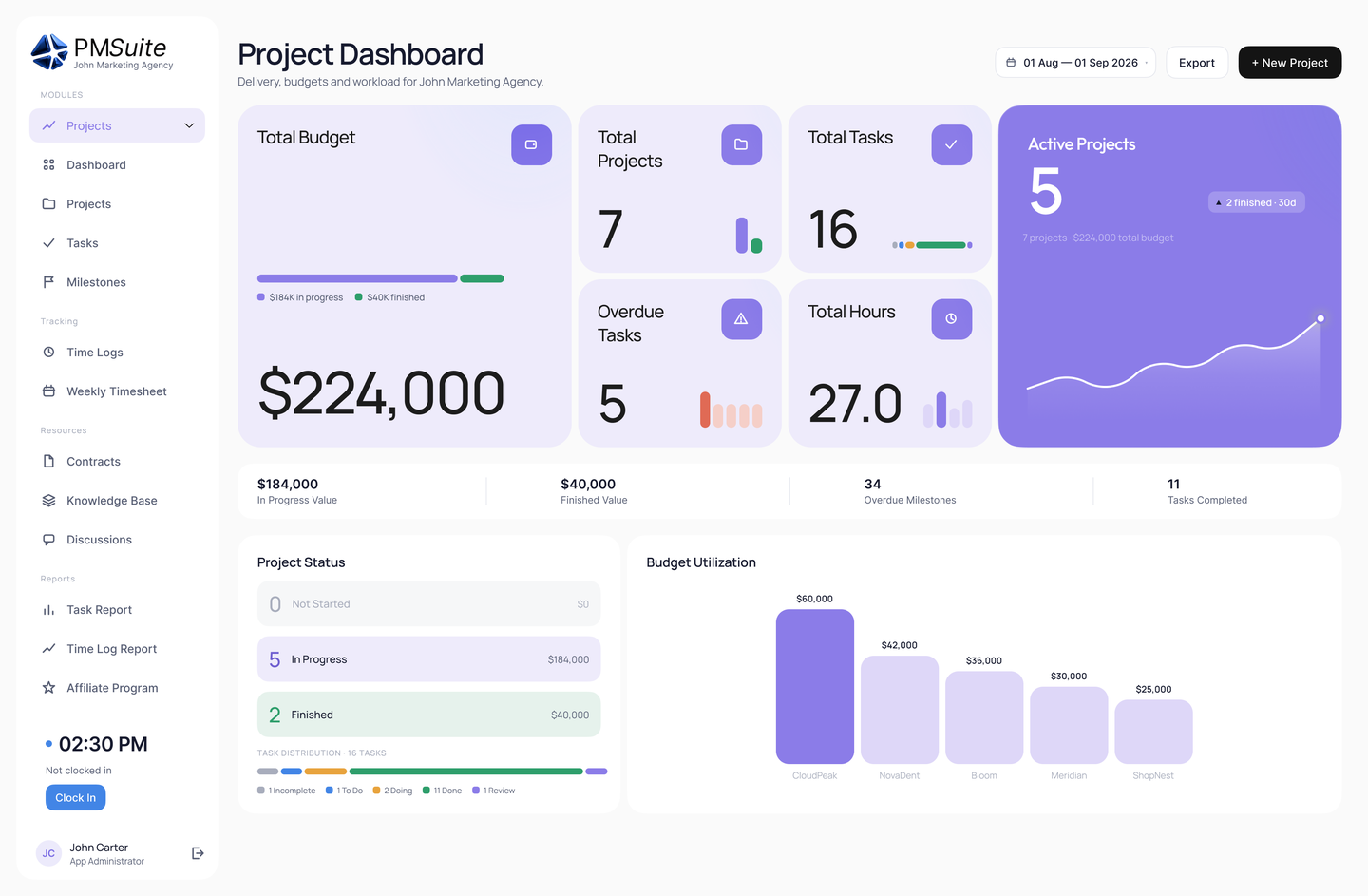
PMSuite's project dashboard helps teams track outcomes and progress without micromanagement.
Create visibility into your own work. When your team can't see you working, they may wonder what you're doing. Share your priorities, explain your decisions, be accessible when needed. Leadership transparency builds team trust. If you expect your team to work autonomously with accountability, model the same behavior yourself.
Maintaining Culture at a Distance
Culture in offices emerges partly from shared physical space—the environment, the informal interactions, the visual cues of how things are done. Remote teams must cultivate culture more intentionally. It doesn't happen by accident; it requires deliberate practices and sustained attention.
Start by defining your culture explicitly. What values guide your team? What behaviors do you expect? What makes your team distinctive? Write these down and reference them regularly. Culture that isn't articulated can't be transmitted to people who aren't physically present.
Create rituals that reinforce culture. Weekly team calls with a consistent format. Celebrations when goals are achieved. Onboarding practices that transmit values. These rituals provide the regular touchpoints that maintain connection and shared identity. Without them, remote teams drift apart into disconnected individuals.
Make space for human connection. Not every interaction should be about work. Virtual coffee chats, team games, interest-based channels—these create the informal relationships that make work enjoyable and collaboration smooth. People work better with colleagues they actually know and like.
Running Effective Remote Meetings
Remote meetings are harder than in-person ones. Technical issues intrude. Body language is harder to read. Conversation is less fluid. Side discussions are impossible. Yet many teams respond to remote work by scheduling more meetings than ever.
Start by questioning whether a meeting is needed at all. Could this be an email? A document for comment? An async discussion? Reserve meetings for what requires real-time dialogue. This isn't about avoiding interaction—it's about using the right medium for the purpose.
When meetings are needed, structure them carefully. Circulate agendas in advance. Assign clear facilitation. Document decisions and action items during the meeting. Keep them shorter than you think necessary—virtual fatigue is real. Respect people's time by starting and ending promptly.
Design for inclusion. Remote participants in hybrid meetings often become second-class citizens—hard to see, easy to forget, difficult to interject. Either commit to fully remote (everyone on their own screen) or invest heavily in technology and norms that give remote participants equal presence.
Supporting Individual Performance
Remote work affects different people differently. Introverts often thrive with reduced interruption and increased control over their environment. Extroverts may struggle without the social energy of office presence. Some people have ideal home offices; others share cramped spaces with families. One-size-fits-all approaches fail.
Have individual conversations about what each person needs to succeed. What are their biggest challenges working remotely? What support would help? What working hours make sense for their circumstances? This individualized approach recognizes that optimal arrangements vary while maintaining fairness in expectations.
Provide more explicit feedback than you would in person. In offices, informal signals communicate how someone is doing—your demeanor, passing comments, inclusion in discussions. Remote workers lack these cues and often wonder where they stand. Regular, specific feedback fills this gap and prevents surprises.
Watch for isolation and burnout. Remote workers can disappear into their work without natural stopping points. They may hesitate to raise concerns when they can't gauge your mood. Check in regularly about workload and wellbeing, not just deliverables. Create space for honest conversation about how people are really doing.
Tools and Technology
Good tools don't make good remote teams, but bad tools make remote work much harder. The right technology stack enables communication, collaboration, and visibility that remote work requires. The wrong stack creates friction, fragmentation, and frustration.
Consolidate tools where possible. Every additional platform creates another place to check, another login to remember, another silo of information. Integrated platforms that combine project management, communication, documentation, and other functions reduce overhead and keep information connected.
Invest in reliable video conferencing and quality audio equipment. Technical difficulties in virtual meetings are more than annoyances—they impair communication and wear on relationships over time. Good cameras, microphones, and internet connections are now business necessities, not luxuries.
Establish clear norms about tool usage. Which channel for what? Expected response times? How to indicate availability? Without explicit norms, people develop inconsistent practices that create confusion. Document and communicate how your team uses its tools.
Hybrid Teams: The Hardest Challenge
Fully remote teams are actually easier to manage than hybrid ones. When everyone is remote, no one has an advantage; all practices must work distributed. Hybrid teams face the additional challenge of ensuring remote members have equal standing with those in the office.
Proximity bias is real. People in the office are more visible, more accessible, more top-of-mind. They benefit from informal interactions and spontaneous opportunities. Remote team members miss out unless you deliberately counteract this tendency.
Document everything as if everyone were remote. Even if some conversations happen in person, capture decisions and share them widely. Don't let important information exist only in the minds of those who were physically present.
Evaluate based on outcomes, not presence. It's tempting to favor people you see working over people whose work you only experience through deliverables. Fight this bias consciously. Judge everyone by the same criteria—what they accomplish, not how visible they are.
The Manager's Own Adaptation
Managing remotely requires personal adaptation as much as team practices. If you're used to leading through physical presence—walking the floor, reading the room, managing by observation—you need new skills and habits.
Become a better writer. Much of what you'd communicate verbally must now be written. Clear, concise, effective writing becomes more important than ever. Practice writing that informs without overwhelming, directs without dictating, and conveys tone appropriately.
Develop comfort with asynchronous work. When you can't immediately ask someone or check their progress, you must wait. This requires trust in your team and systems that provide visibility without constant checking. Learn to work with information that isn't quite current and decisions that take time to finalize.
Model the boundaries you want your team to maintain. If you send messages at midnight and expect immediate responses, you create always-on expectations that burn people out. Demonstrate healthy work patterns, respect others' time zones and schedules, and explicitly communicate that after-hours messages don't require immediate replies.
The Future of Team Management
The shift to distributed work isn't reversing. Even as offices reopen, the genie of flexibility is out of the bottle. Talented people have experienced remote work and many prefer it; companies that demand full office presence limit their talent pools.
The managers who thrive will be those who master distributed leadership. They'll build teams that are connected despite distance, productive despite flexibility, and engaged despite physical separation. These are learnable skills, but they require unlearning old habits and embracing new practices.
Start where you are. You don't need to transform everything immediately. Choose one area—communication, meetings, culture, feedback—and improve your practices there. Then move to the next. Incremental progress accumulates into fundamental change. The remote era rewards those who adapt deliberately and continuously.
To keep remote work visible, see how PMSuite’s project management software organizes tasks, time logs and team discussions.
Unite Your Team with PMSuite
Our team workspace brings communication, collaboration, and project management together—giving remote and hybrid teams everything they need in one platform.
Start Your Free Trial7-day free trial • No credit card required